Good Interview Questions and What Interviewers Are Really Listening For
By Caleb & Mary Beth Lutz · August 26, 2026 · pairs with Episode 9: Good Interview Questions and What Interviewers Are Really Listening For
Have you ever wished you knew what interviewers were really asking? You're not alone.
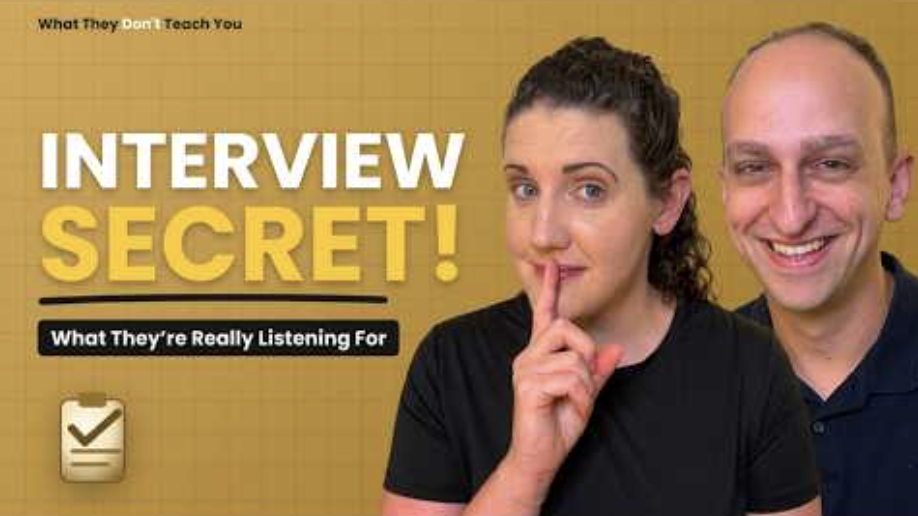
This is a written companion to our first video on interviews, not the standard top-ten-tips list, but what interviewers are actually listening for underneath the questions. The full episode is below. If you'd rather read, we cover four things: why interviewers ask what they ask, the real question behind the common ones, what values and traits they're actually listening for, and the questions you can ask back that show when you're a strong fit.
This one's timely for us. Mary Beth just went through a high-level sales interview process and landed the role. Caleb just ran hiring for one of the first leadership roles on the freight team. So we're each speaking to this freshly from different sides of the table.
First, a quick word on nerves
If interviews terrify you, you're in good company. Caleb shared that as a young job seeker he was genuinely terrified, hated the thought of someone deciding in five or ten minutes that he wasn't a fit, and had every disqualifying thought running: I don't have the experience, why would they pick me. And this was for a bus boy job at a Mexican restaurant in college, not some high-level position. The fear wasn't about the stakes. It was about not feeling qualified and not knowing what they were looking for.
Mary Beth came at it differently. She grew up in an Italian family where everyone communicated constantly, so presenting herself felt more natural. But she still did real research and devoured content before going in. So wherever you fall on that spectrum, terrified or confident, the same preparation applies, and you're in the right place.
The mindset that helps most, especially once you've sat in the hiring seat: an interview is not someone trying to hack you apart or intimidate you. A good interviewer is just trying to find a good fit. Once you see it that way, being interviewed becomes a conversation. You're open about who you are, clear and concise, and you go from there.
Point 1: Why interviewers ask what they ask
The biggest unlock is realizing every question is intentional. The interviewer isn't randomly checking trivia. They're screening for a few specific things:
Can you do the job? Do you have the skill set for this role?
Will you stick around and be easy to work with? Hiring is extremely expensive, so churn and friction are real risks.
How will you represent me to my customers? If you show up to the interview in a wrinkled t-shirt, you might be a great person with your own vibe, but if that's your read on a professional setting, that's a red flag for how you'll show up to clients.
Almost every question maps back to one of those three: can you do it, will you be worth what we pay you, and will you represent us well. Once you know that, you can hear the real question underneath the common one.
Point 2: The real question behind the common ones
Take the classic opener, "tell me about yourself." Caleb shared that as a candidate he hated it, thinking, which part of my 18 or 19 years of thin experience do you want? But as an employer now, it's one of his favorite questions. What he's really listening for is: can you concisely pull together the basics of who you are in a way that connects to how you'd help meet the needs of our customers? A good answer gives a little humanity, here's where I come from, then pivots fast to a few real skills and why they brought you here today.
Then there's "what's your biggest weakness?" They are absolutely not looking for you to claim you have none. Please don't do that. PLEASE don’t give a fake strength as a weakness. They can see right through it. The real question is: are you self-aware, and are you willing to humble yourself and be honest?
Mary Beth shared that in her last interview this was the turning point. She brought a genuine weakness she'd worked on in her career, named how she used to be with people, and walked through the coaching and mentorship she sought to grow past it. The interviewer later responded that she was one of the most self-aware people he'd talked to, and she believes that honesty is a big reason she got the role.
As Caleb puts it from the hiring seat, everyone around you already knows your weaknesses, so when you name them yourself, it's a relief, not a red flag.
Point 3: What interviewers are actually listening for
When a candidate says "I might not have done exactly this, but here are the skill sets I bring, and I'm willing to learn," that's music to a hiring manager's ears. It signals ownership and coachability, and it beats false confidence every time. The specific hyper-focused parts of a job can often be trained. What's hard to train is attitude and character.
The fastest way to lose the room is playing the victim. Caleb shared that one candidate opened by maligning their last boss and, using the phrase “after all I've been through”, then proceeding to beat that boss’s character into the ground. As a potential employer his read was immediate: no matter what I do, you'll be thinking about everything you've been through, you'll expect me to be perfect, and you'll badmouth me to everyone later. Low drama is deeply attractive. High drama and blaming others, no matter how justifiable it may be, not so much.
So what they're listening for is clarity, ownership, low drama, and specific relevant stories, delivered with a neutral, professional, open tone. Something like, "I actually think I'm a strong fit because of this and this, and I wanted to ask about this, which may be a growth area for me." That kind of self-initiated honesty communicates maturity and a growth mindset. Whether or not you get hired, it's the kind of thing that makes an interviewer want to refer you to others with a high recommendation.
Point 4: Good questions to ask them back
Great questions flip the interview around. This is your chance to evaluate them, which is healthy, because you're deciding whether you can see yourself there.
A few that work well:
"What are the top performers here doing that the folks at the bottom aren't?" Or, "In the first six months, how do the people who win separate themselves?" Caleb shared that this is his own instinct in anything competitive, from sales to athletics: he just wants to know how you win. Asked genuinely, it also lets you listen for whether the company actually has training and development that they invest into their new hires with that you can plug into.
"What are the biggest challenges people face in this role?" You're feeling out whether those are things you can overcome, or whether they point to a leadership or culture issue worth knowing about now.
Questions about the day-to-day and the team culture, asked because you genuinely care, signal that fit matters to you. Even, "will I get a chance to meet the manager and see if we're a good fit?"
There's a professional way to communicate what you need. Caleb, for instance, works best with autonomy, told the end goal and left to run without being micromanaged. Owning that plainly is a great sign to a quality employer, even if it reveals you're not a fit for a particular company.
One rule: skip asking anything you could have answered from their website. Do the research. Even better, reference it: "I noticed this on your site and was curious about it." And if you know who's interviewing you, a quick look at their background for common ground shows you're a real, relational person. If you're in Kansas City as well, talk about the Chiefs. Relate, and have a little fun with it.
The takeaway
Interviews get a lot less scary when you can hear what's really being asked. To recap the four points: understand why interviewers ask what they ask, learn the real question behind the common ones, know the key values and traits they're actually listening for (clarity, ownership, low drama, specific stories), and bring good questions of your own. Training yourself to hear the real question underneath is the biggest piece.
If you want to go deeper, keep an eye out for the "Coming Soon" Authentic Sales Playbook on our resources page. It might sound odd to connect sales to interviews, but an interview really is finding the needs of an employer and showing them how you can fill them, which is selling yourself at its most honest. If there's a topic you'd like us to cover, please reach out via Connect With Us or comment on our videos. We read every one.
And remember, you always have a choice to change your life if you choose it. We believe in you.
🎯 Start here: theydontteachyou.com/start-here
📩 Keep an eye out for the Coming Soon Authentic Sales Playbook and browse every resource: theydontteachyou.com/resources
