Public Speaking Tips That Actually Work: The Crash Course Nobody Gave You
By Caleb & Mary Beth Lutz · August 26, 2026 · pairs with Episode 8: Public Speaking Tips That Actually Work: The Crash Course Nobody Gave You
You don't have to be fearless to be great at public speaking. You need to be prepared, and preparation is something anyone can choose.
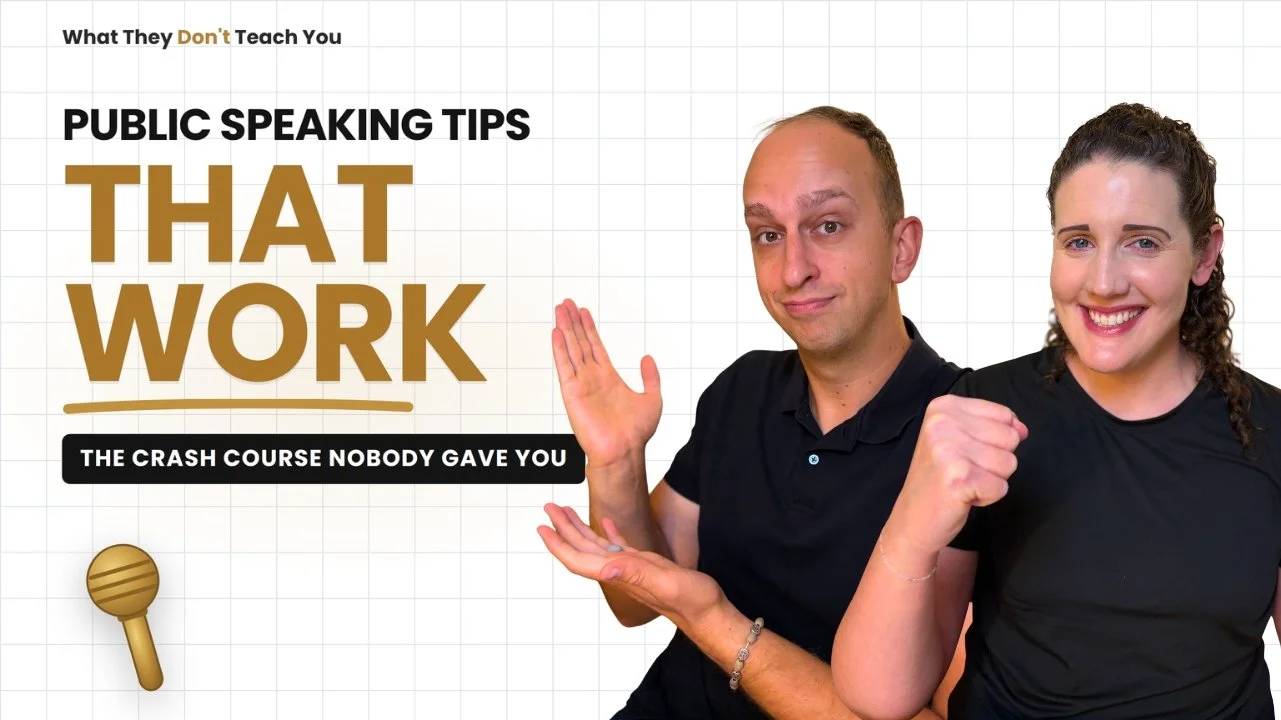
This is a written companion to our video on public speaking, the number one fear in America, ahead of the fear of heights, spiders, and apparently even dying. The full episode is below. If you'd rather read, here are the three points we cover: preparation beats talent, manage the nerves instead of fighting them, and connect with people instead of trying to impress them.
One quick reframe before we start. When people hear "public speaking" they picture a stage. We do touch on that, but the real goal is communicating effectively with your audience, whether that audience is a room of hundreds or just your spouse. Communication is one of the most essential assets to your success, whether you're an entrepreneur, a salesperson, or a stay-at-home parent. It's hard to think of a single area of life that better communication doesn't improve, which is exactly why it's worth getting more intentional with and less afraid of.
Point 1: Preparation beats talent
For Caleb, two things scared him most: public speaking and being the one interviewed. He shares that a big part of it for him was growing up homeschooled and more introverted, not always knowing the movie references, the music references, or the mannerisms other people took for granted, so his natural state was to sit back, observe, and “figure out” how to relate. You can have a big heart to help people and genuinely love being around them, but the missing social info plus the fear of strangers judging you in the first 30 seconds, deciding this guy is boring, this guy doesn't know how to relate to us, heightens the fear even more.
Here's what changed it: preparation.
Even before recording this episode, both of us had nerves and went through our own little prep sequence to focus them. Nerves don’t signal a lack of prep, after years and hours poured into preparing this content. It's the opposite. Your body preps you because you care, a little signal that says this is important, you have something to do here.
And the fix for the fear is almost never raw talent. It's your outline. Shout out to John Maxwell, one of our favorite leadership and communication voices. In his book The 16 Undeniable Laws of Communication, he shares that he brings notes to every single talk he gives, and this is a man with decades of speaking, an entire coaching platform, and dozens of books behind him. If the seasoned pro still prepares, so can you.
Think about how you were trained. Teachers always told you what was coming: here's today's plan, here's the syllabus, here's what to expect. You're used to walking in with a map. Public speaking works the same way. Even for a video like this, we work from an outline, and just having the pre-planned talking points with an intentional mission calms you down.
Practical ways to prep
A few things that genuinely helped:
Put yourself in low-stakes reps. Caleb shared that he drove Uber for years while paying off college debt. It made extra money, and it turned out to be an ideal place to practice, with someone in the back seat rather than face to face, he had a beat to respond, and he got to start conversations one at a time. If a conversation flopped, he had time before the next ride to think back through it: how could I have handled that better, or what did we actually have in common even though we disagreed on something? Reps like that build the muscle without a stage.
Look into Toastmasters. If you're not familiar with the organization, their tagline is "where leaders are made," and the whole practice is public speaking with constructive feedback. The reason that matters is that getting good at communicating builds the exact skills you need to lead others. The structure lets you build progressively, from standing up to read a fun fact for the day, to giving a short speech, to reviewing others' speeches, to guiding a whole meeting. It's a rare, structured on-ramp to the skills where you choose your pace of progress and have a peer group all working to progress at differing stages.
Try mental reps. Like shadow boxing for a fight, close your eyes and picture yourself in front of the room, walk through the conversation or speech, and decide what matters most to get across. And team up with someone who's good at this. We bounce things off each other constantly: if I say it like this, how does that land?
Point 2: Manage the nerves, don't fight them
Even before this video, one of us was doing little chores around the house that didn't need doing, and realized, I'm nervous to do something I've done hundreds of times and genuinely love. That was the tell. The nerves weren't a sign of being unprepared. They were a sign of caring how it turns out.
That realization is the shift. The nerves mean this matters to you, and there's something freeing in that. The goal was never to make the butterflies disappear. Even seasoned speakers still feel them. The goal is to stop reading them as a warning and start reading them as fuel.
Mary Beth shared the reframe that helped her most. She heard someone describe the butterflies before speaking as either excitement for what's coming or dread about what people will think. So she started reading the butterflies as "what's the best thing that could happen here?" instead of the worst. We so often default to "what's the worst that could happen," and that one mindset switch, aimed at the best case instead, did more for managing nerves than anything else.
And when she's waiting to be brought up on stage, she looks through the crowd and makes eye contact with as many people as she can, even a little eyebrow raise or a "let's go." It's a reminder that she's there to talk with individuals, not to perform something grand. That's the bridge to the third point.
Point 3: Connect, don't impress
The best speakers we've seen aren't trying to impress anyone. Impressing isn't the job. People choose who they watch and who they follow. You don't need to win that. You're there to connect, and maybe to inspire.
Maxwell puts it well in Everyone Communicates, Few Connect: if you want to impress people, tell them all your successes. If you want to inspire people, tell them your mistakes, your journey, the parts where you struggled. Not trying to be someone you're not is where the power actually comes from.
That ties to what Maxwell calls the law of authenticity. We live in a polished, social-media world that can seem to demand perfection. You don't have to accept that demand, and that's a whole other conversation, but all of us share the common ground of not being perfect, and that's exactly where connection happens. Honestly, when someone brings us a resume of every great thing they've ever done, part of us wants to ask them to tell us about some of the struggle instead, because that's where we'll actually connect. The polish keeps people at arm's length. The honesty and unimpressive, relatable struggles pulls them in.
As our fun example today, which picture to you relate to most: us suited and booted ready to jump on stage OR us hanging with a chicken statue outside the venue during down time?


That’s what we thought.
So if you remember one thing: choosing to be vulnerable, authentic, and just yourself will always be more effective than performing as someone you're not. That's not just kinder to your nerves. It's more effective in the room.
The takeaway
You don't need to be fearless. If you're just starting your public speaking journey, welcome to the club. We've all been there, standing off to the side feeling like we didn't have the talent or the charisma, and prepping ourselves anyway. When we cover the basics of public speaking and removing your own fear of it, here are our three moves we’d recommend: your preparation matters far more than your fearlessness, you leverage the nerves instead of fighting them, and you connect with people instead of trying to impress them.
This is a mindset and a starting three, not the whole map, and we'll dive into more specific how-tos over time. But this trio is a great place to launch from, because it's the part most people skip while waiting to magically feel ready. If public speaking is something you're working on, or you've had a recent win with it, we'd love to hear about it in the comments. We read every one, and it shapes what we build next.
And remember, you always have a choice to change your life if you choose it. We believe in you.
🎯 Start here: theydontteachyou.com/start-here
📩 Browse every free resource: theydontteachyou.com/resources
