Job Interview Tips That Go Beyond "Just Be Yourself"
By Caleb & Mary Beth Lutz · August 26, 2026 · pairs with Episode 10: Job Interview Tips That Go Beyond "Just Be Yourself"
"Just be yourself" might be one of the more useless pieces of interview advice anyone's ever handed you. If being yourself were enough, you'd already have the job.
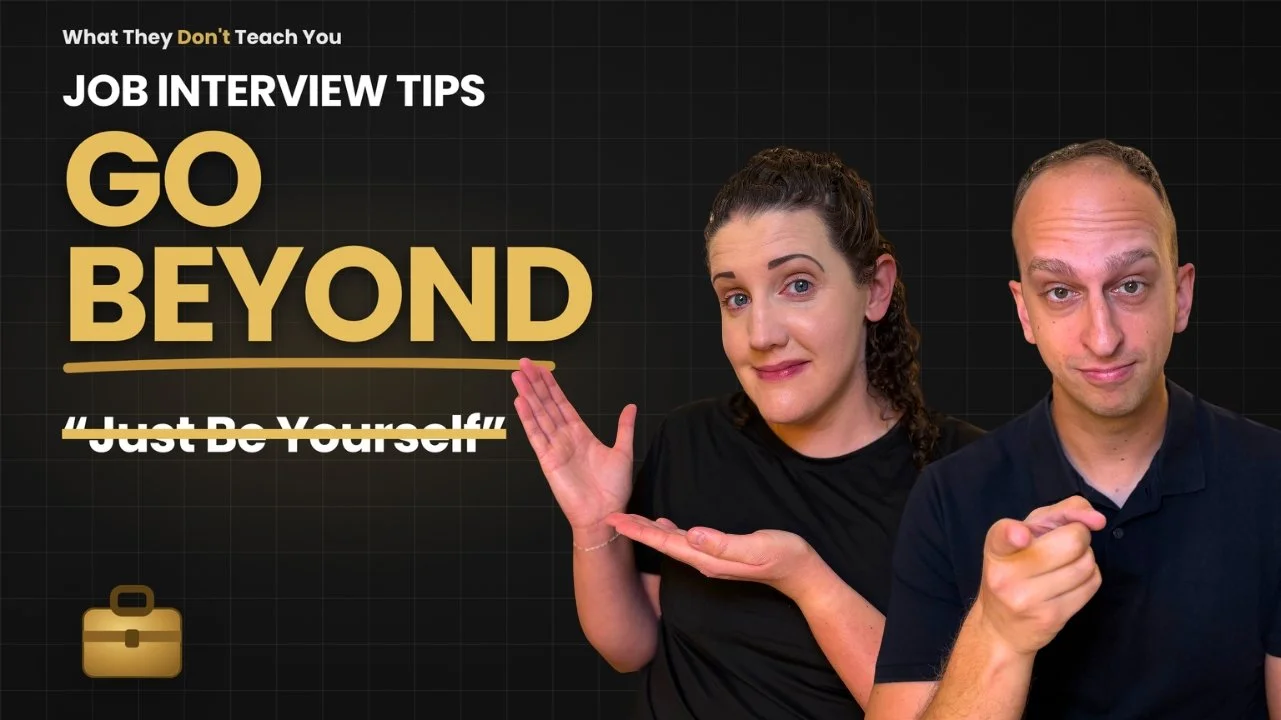
The truth is, the people who nail interviews aren't just being themselves. They're being a prepared, sharpened, intentional version of themselves, and none of that is fake. This is a written companion to our video on going beyond the advice that sounds nice and does nothing. The full episode is below for those of you who’d like to see us discuss and example the recommendations via video. If you'd rather read, we cover four tips: be your prepared self, trade adjectives for evidence, solve their problem instead of showing off your resume, and manage the energy in the room.
Tip 1: Be your prepared self, not your raw self
The most "natural" person in the room is rarely winging it. They practiced. One of our favorite leadership coaches, John Maxwell, prepares for every single talk and training he does, after decades in the field. Preparation is the professional's habit, not a beginner's crutch.
Caleb shared the opposite example from the hiring round he just ran for the freight agency: 50 applicants, 30 first interviews, about 20 calls, narrowed to five, then one. His opener was simple, "tell me what had you submit your application and why you thought you'd be a good fit." On one call, the candidate's response was, "I'm sorry, can you remind me which interview this was for?" That was it. The interview was effectively over, because it revealed someone mass-submitting with zero intentionality, and if you show up like that to an interview, how are you going to show up to the business’s customers?
Now flip it. The candidate who comes in with "Yes sir, here's what I read in your posting, here's why I thought I might be a fit, and here's my brief experience so far" puts you straight into a real conversation, and you can go from there.
To a business owner, hiring is a risk. Why invest $50,000 or $100,000 in someone who doesn't show they can solve the problem the job exists to solve? Preparation isn't fake, and it isn't sucking up. It's respect for the interviewer’s time, and honestly, showing up unprepared reads as a little disrespectful, like, why would I want to spend more time with you?
One more piece: for most jobs above entry level, there's industry lingo you'll be expected to speak. In freight, it's load coverage and claims and PODs. In tech sales, it's lead generation and ICP among others. A marketing role is different from an ops role is different from a server role. So the question is, are you coming in with just your personality, or with your personality plus real industry knowledge and a genuine read and curiosity about the company. Do the work, and you'll stand out from the first minute of the interview.
Tip 2: Trade adjectives for evidence
Everyone says the same things: I'm the hardest worker, I'm really detail-oriented, people love me. Great. Cut the fluff and prove it with a story instead.
Rather than "I'm a hard worker," try: "I grew up on a farm. Normal for me was getting up with the sun, working the whole day, and still tinkering in the shop by sunset to prep for tomorrow." That one example tells an interviewer the kind of workload this person is used to, without ever using the word "hardworking." The move is simple: think of a few adjectives people would genuinely use to describe you as a fit for the role, then think through a quick 30-second story ready for each. When they ask "tell me about yourself," the specific story that helps them get to know you is what sticks in memory, not the adjective.
Caleb shared how an evidence-based story became the deciding factor in his final round of interviews. In freight, conflict management is non-negotiable, so he needed a real example of a time conflict blew up and the candidate had to solve it. The difference between the final two came down to who could concretely answer that. One candidate stood out in other ways but got wishy-washy and avoided the question, twice, showing they were conflict-avoidant. The other listened, and answered with a direct story of how she had to handle conflict-filled scenarios, even when they were uncomfortable and even a challenge at times.
Concrete, direct answers beats abstract fluff every time.
Tip 3: Solve their problem instead of showing off your resume
Here's the reframe that changes everything: think about the problem they're having, not just the stuff you've done.
There's genuinely an element of sales to interviewing. Sales at its core is finding a need and filling it (Caleb will happily point out this is how he won Mary Beth’s number). Every job posting exists because of some pain point. Something is missing, something is broken, or the company is growing fast and needs someone to come figure out the pain and speak straight to it.
So read the posting like a problem statement and ask yourself, what does this team need that they don't currently have, and how can I fill that gap? A lot of the "must-haves" at the top of a posting are pain in plain sight. When you can say "here's what I’m hearing you need fixed, is that right? Here's a time I fixed something like it," you jump past the surface stages of the interview to what they actually care about. And if you're not sure what the core pain is, ask: "Here's what I picked up from the posting, is that the main reason you're hiring for this role, or what are the top two or three essentials you know you have to have?"
Tip 4: Manage the energy in the room
The simple version: feel the energy, match it, then raise it just a little.
You'll hear people say always bring big enthusiasm, and sometimes that fits. You'll walk into an energetic room and hit it off. But most interviewers are trained to stay neutral, no-nonsense, pretty straight-faced, because they need real answers. Don't let that flatten you or throw you. Match the neutral tone, then add a little warmth and zest with your examples, and settle back. If they're slow and thoughtful, slow down to meet them before you pick up. Energy is felt more than performed.
Mary Beth shared how this challenges her personality type specifically. One of her top CliftonStrengths is woo, winning others over, so she's naturally bubbly and people-oriented. Early on, interviews were tough because she'd come in warm and get very little back, not realizing interviewers are trained to be neutral. Her advice for fellow people-people: come in as your best prepared self with your stories ready, bring a little flair, and don't panic when you get a flat face. In her last interview, she studied and learned the interviewer was from New York, and with the friendly football rivalry that comes with being from Kansas City, she brought it up early. Calm and present, then raised just a little with a touch of personality. A genuine personal connection.
The takeaway
"Just be yourself" isn't enough, and now you have a few tools to get to that next layer of depth. To recap the four tips: be your prepared self rather than your raw self, trade adjectives for evidence, solve their problem instead of showing off your resume, and manage the energy in the room by matching it and raising it slightly. None of this is pretending. It's being who you are, sharp, intentional, and prepared.
One last thing worth remembering: the real preparation is the years of your life leading up to now. You're drawing on who you are, not becoming someone else. Some roles you'll be an excellent fit for, others you won't, and that's fine. What matters is bringing your most prepared self and owning it, while showing you want to stretch and grow to the next level.
Caleb shared that even when an applicant isn't the right fit for him, if they show up that way, he'll go out of his way to refer them to others who are hiring. The broader principle holds too: the more you present your genuinely intentional self to everyone you meet, the more opportunities and doors open up, even when it's not that particular one. For a deeper dive, this pairs closely with our companion piece on what interviewers are really listening for.
If you want to go further, keep an eye out for the "Coming Soon" Authentic Sales Playbook on our resources page. An interview really is selling yourself, finding a company's needs and showing you're the one to fill them, done without any sleaziness.
Comment on our videos or reach out via Connect With Us if there's a topic you'd like us to cover.
And remember, you always have a choice to change your life. We believe in you.
🎯 Start here: theydontteachyou.com/start-here
📩 Keep an eye out for the Coming Soon Authentic Sales Playbook and browse every resource: theydontteachyou.com/resources
