By Caleb & Mary Beth Lutz · July 25, 2026 · pairs with Start Here: Episode 3 - Why Career and Income Freedom Actually Matters
Freedom sounds like a luxury word. Something for rich people, or lucky people, or the folks online with the fancy cars and the followers. Our take: it isn't. This is about your time, your choices, and who gets to decide how you live. And it's worth understanding well, because it matters waaaaay more than just another raise.
We’re Caleb and Mary Beth Lutz, our story is in our previous blog & video, but we’re here building out the income and freedom resources we spent years wishing someone had worked through with us sooner. So let's actually define income freedom, look at why it matters more than a raise, be honest about what it costs to ignore it, and get to the encouraging part underneath all of it.
I (Caleb) am not trying to talk you into anything here. But I do want to give you a clearer way to think about freedom so you can decide what you want for yourself.
Watch Episode 3: Why Freedom Actually Matters
What income freedom actually means
Set aside the jets and the permanent beach. For most of us, that's not the starting target.
Income freedom starts with being able to say no.
No when your boss asks for something you shouldn't do. No to an environment you don't want your kids growing up around, because you can afford to move. No to the client who only calls at the last minute and only when they want something at the cost of your family time, because you can find a better fit if needed.
It's having enough income that you can make the choices you'd make if income weren't the deciding factor.
The trade underneath it
Underneath all of it is one quiet trade. To make income, most of us spend our most limited resource, which is time.
Everybody wants more time, and nobody can make more of it. We all get 168 hours a week. That's the whole “time” budget, the same for all of us.
What you can change is what happens inside the forty, fifty, sometimes seventy hours a week you pour into earning. You can start absolutely start buying yourself options with them.
Options look like time with the people you love while they're still here. Being able to help when a family situation lands or a parent moves toward retirement. A slow month you can ride out because something else is coming in. A layoff that's a setback instead of a catastrophe.
Some people call it FU money. I'd call it choice income. It's the ability to say "this matters more" and then act on it.
Why it matters more than a raise
A raise feels like the answer, and often it deepens the problem instead.
A raise is still tied to the one job funding your whole life. Take enough of them and the internal math shifts. You start assuming nobody else would pay you this. You start feeling you can't risk starting over. Your lifestyle rises to meet the number, the benefits are tied to that desk, and one by one your options narrow. That's what golden handcuffs are, not a punishment, just a slow narrowing until leaving feels impossible.
None of this is an argument against your job. We want loyal employees as much as any owner does in our companies, but we also want them holding the job with an open hand, free to leave for a better fit if we can’t provide it.
There's nothing wrong with earning well where you are. The useful question isn't whether the money is good. It's what it might be quietly costing you.
Mary Beth puts it beautifully in our video conversation:
A raise makes the cage nicer. Income freedom hands you the key.
What it costs to ignore this
Money is a heavy topic for a lot of people. Depending on how you grew up, it was either never discussed or only came up in a fight, and either way it's easy to just not look. Here's what I've watched happen when people don't.
The midlife crisis wall
The pattern I see most in people a bit ahead of us is a wall around forty or forty-five. They've only ever run one system. Maybe they job-hopped a bit and none of it felt like much, but most settle into a career for a slightly bigger number each year while every choice they had got quietly tied to that one place. And then, “all of the sudden”, they can’t stand that place because it’s removing their choices from them but they’re freaked out too much to start over.
Call it a midlife crisis. Call it burnout. It's real, and it's common.
We share the story of a friend of ours who runs his own small business. This year, in his late forties, he finally hired an assistant so he could take his first family vacation in more than a decade. And Good for him for doing it. He also told us what it stirred up, his grief over the time he missed, and that with his parents nearby and aging, it might be one of the last long stretches he gets with them.
The loss is another side of the same coin of putting all eggs into one income basket, then losing the time and choices that matter most in our personal life because of it.
The cost of chasing one thing at any cost
Here's another Mary Beth shared. A man got promoted to CEO, the top of the ladder he'd been climbing his whole career. The same day, his wife told him she wanted a divorce and his kids told him they didn't want to talk to him anymore.
Ambition is good, and chasing something matters. To us, it's still worth asking what's at stake if you never diversify, never protect your time, and pour all of it toward one summit.
Life experience tells us, most of us are also closer to an emergency than we'd like to think. I don't enjoy dwelling on worst cases. But when you have flexibility and someone you love is struggling and you need to go, you can go.
The encouraging part: this is learnable
Here's what I most want you to take from this. Freedom is mostly habits, and habits can be learned.
Almost every wealth-building move is a behavior you repeat, not a talent you're born with. And here's the reframe that stuck with me: the energy it takes to stay stuck is roughly the same energy it takes to live comfortably, which is roughly the same energy it takes to build wealth. The difference isn't necessarily how hard you work (you Have to be willing to work hard to win at any level). It's which skills you learned and which habits you kept, especially the ones that don't obviously pay off at first.
It's the fifty dollars a month set aside. Mary Beth's dad had her doing that young, and she didn't see the point for years. I never saw it modeled at all growing up. That's a compounding gap, and it starts almost invisibly small.
If you want one book on this, read The Compound Effect by Darren Hardy. Another is Atomic Habits by James Clear, even more focused on the how-to behind habit formation. Most people think getting free takes one dramatic overhaul. It's actually small, unglamorous choices stacking up until the math is on your side.
Where to start: find your Escape Number
If you want a first concrete move, find your Escape Number.
That's the amount of outside-your-job income that would give you real options. It's the moment freedom stops being a vague feeling and becomes a specific target. Instead of "I want to feel less trapped," it turns into "I need this much coming in from outside my job, and here's the plan to get there."
The Freedom Budget Tracker walks you through finding yours from your actual expenses and goals. We built it and had others pressure test it to see if it helps. We'd genuinely value your honest feedback once you've run your numbers.
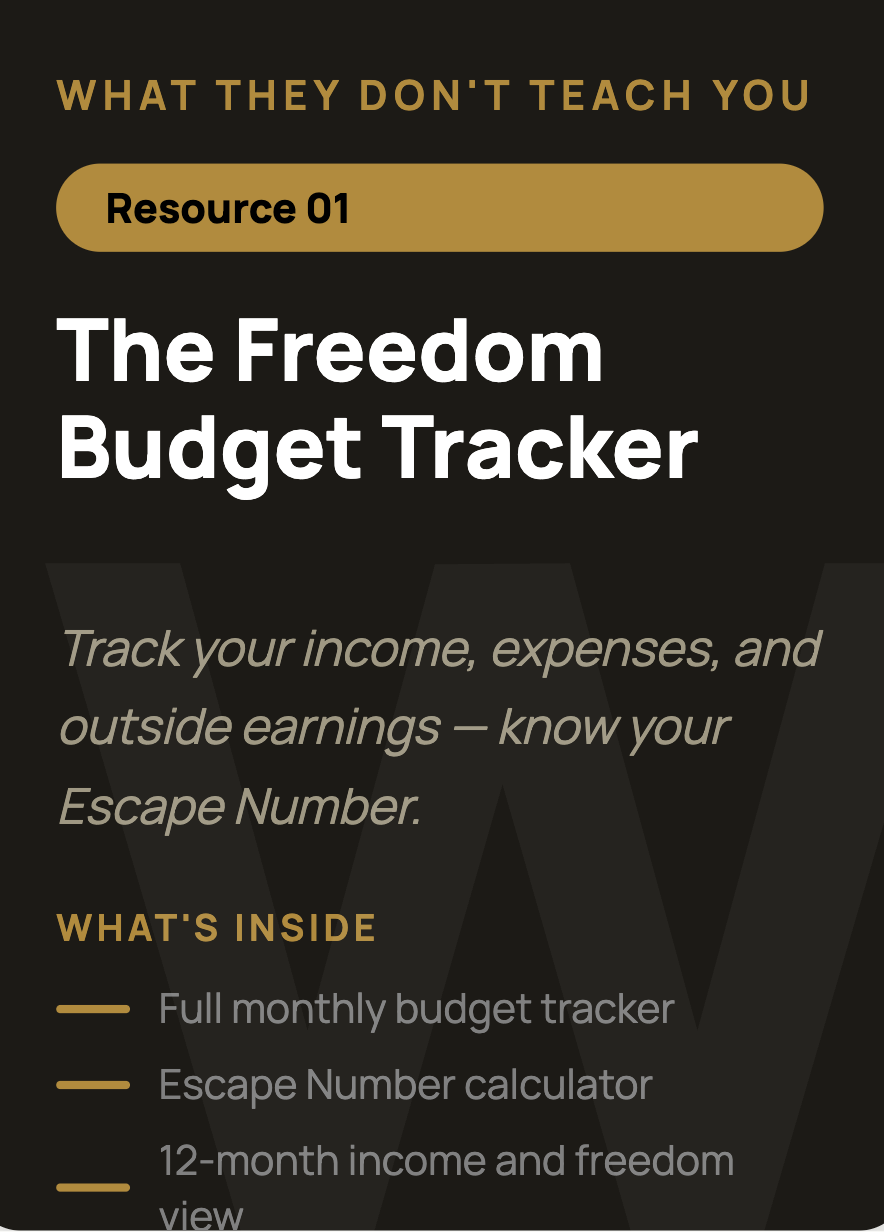
Find on our Resources Page: The Freedom Budget Tracker
Final thought: find your one number to start with
Income freedom isn't a luxury you unlock after you're already rich. It's a set of learnable habits that hand your choices back to you, one at a time.
It matters more than a raise because a raise makes the cage comfier and freedom hands you the key. And it's worth understanding early, because the alternatives - the midlife crisis, living the same year on repeat for 40-years, the family member you couldn't show up for when life hit them - tends to cost far more than the effort of building.
So start with one number. Once you use the Freedom Budget Tracker to find your Escape Number, we'd honestly like to hear what clear and what’s not so we can keep upgrading our tools over time. This is how it gets better for the next person.
We believe in you. You always have a choice to change your life.
🎯 Start here: theydontteachyou.com/start-here
📩 Get the free Freedom Budget Tracker and browse every resource: theydontteachyou.com/resources
