By Caleb & Mary Beth Lutz · July 25, 2026 · pairs with Start Here: Episode 2 - Why We Started What They Don’t Teach You
A few years ago, Mary Beth and I (Caleb) were two single teachers who passionately loved our work. I was used to living lean, while Mary Beth was learning to survive in under-poverty-line pay for the first time. Both of us were working multiple jobs and could still barely pay the bills. We'd done what we were told to do, and were living financially stuck at best.
This is the story of how that turned into the project you're reading now. I'm sharing it because the thing that actually moved us wasn't luck or a windfall. It was a change in how we understood money and the skills around it, and that's something anyone can work toward.
We came at all of this from two pretty different starting lines, so my recap here will walk you through both, then the turning points, then what we finally realized.
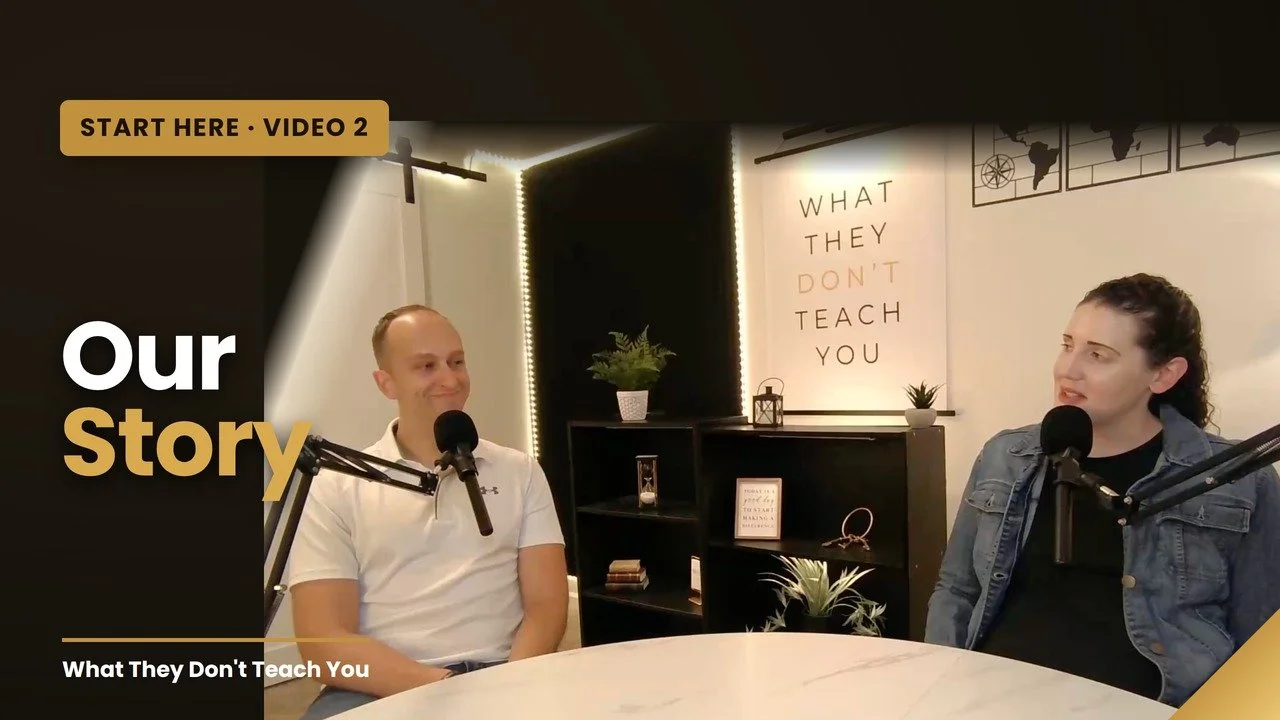
Watch “Our Story” from Episode 2
Two different starting lines
If you've ever felt like your background counts you out, one of us probably started somewhere near where you are. Our two stories run in opposite directions.
Where I started
I (Caleb) grew up on a farm in South Georgia, one of nine kids, parents still together. We were rich in the things that matter most, character and faith and people I'd still call heroes. Money was the piece that was usually missing.
When I was four we lost the bigger family farm. My dad ran a few startups while still working the land. One lead to the next, but it turned into years of hope and hope lost with each failure. When I was ten, we got to the point where we had to sell the house and our own land and moved to the edge of Atlanta to start over on a leveraged home.
I was a kid, so I didn't process it as loss. What I remember is the big family breakfasts where we prayed about where the next money was coming from. And I remember that money mostly came up in a fight. Where did this go? How are we covering that? How could this be missing? Don’t you know we’re still behind…? So I grew up associating money with stress. My way of coping was to not think about it.
That was my money mindset, though I wouldn't have called it that. You pick one up whether you choose it or not, and mine was basically: money is stressful, so look away.
I was homeschooled the whole way through. Starting in fifth grade, I watched a video teacher lead a class, teaching by playing games with students, and I thought it was the coolest thing I'd ever seen. From that day on, all I wanted to do was be that kind of empowering teacher, and I followed that all the way into the school system, despite many warnings from family and friends that I’d never make a living doing it, figuring I'd do it for life and just ignore money the whole way.
Little did I know how much of life revolves around those choices.
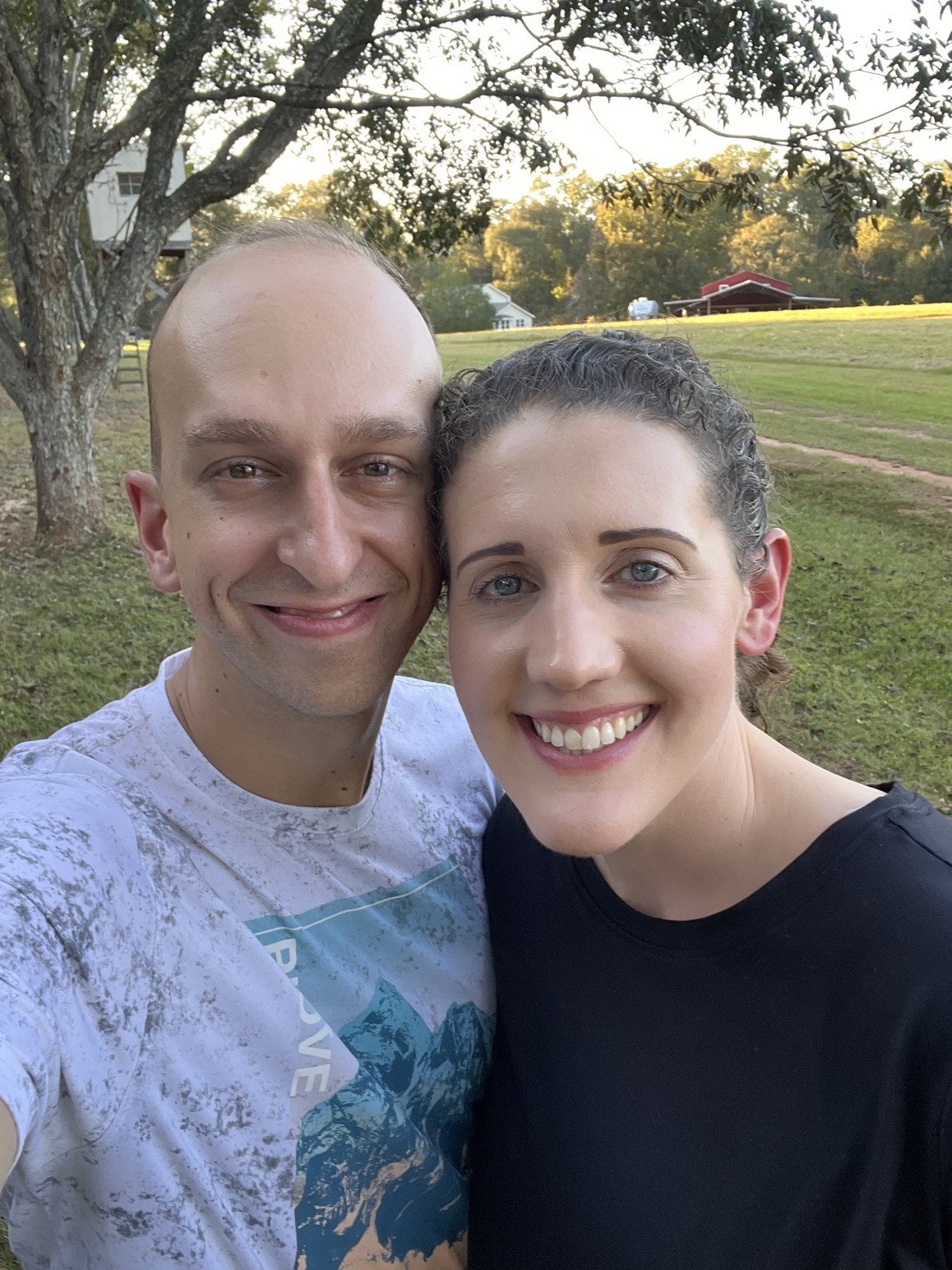
Caleb and Mary Beth in front of the old Lutz farm in South GA
Where Mary Beth started
Mary Beth grew up in the opposite setting, in the western suburbs of Chicago, in one of the wealthier counties in the country. Good schools, comfortable life. When I first told her that my family sometimes prayed for food to show up, she genuinely couldn't picture it. Her family always had enough. They ate out, went to the movies, took vacations. Always had enough.
Everyone's normal is just their normal. Hers happened to be the reverse of mine.
She tells it that she didn't think about money at all until college. It was 2007-2008, her dad worked at a senior level in the mortgage industry. One morning her freshman year, he came home at 10am holding a white box with all his things in it. Her mom asked what he was doing home. He said they'd shut his branch down… career was gone.
Mary Beth had never known anyone to be laid off until that point. What stuck with her was the after effect. The pantry got thinner. The dinners out stopped. The vacations shrank and mostly disappeared.
But she also watched her dad open his laptop every single day and apply with a discipline she still respects. When the market gave him nothing, he started his own mortgage company just under a year later. Her parents eventually retired well. It stayed lean for a long stretch, but they made the best of what they had.
That's when she first thought she needed to pay attention to money, because it clearly changed everything around it.
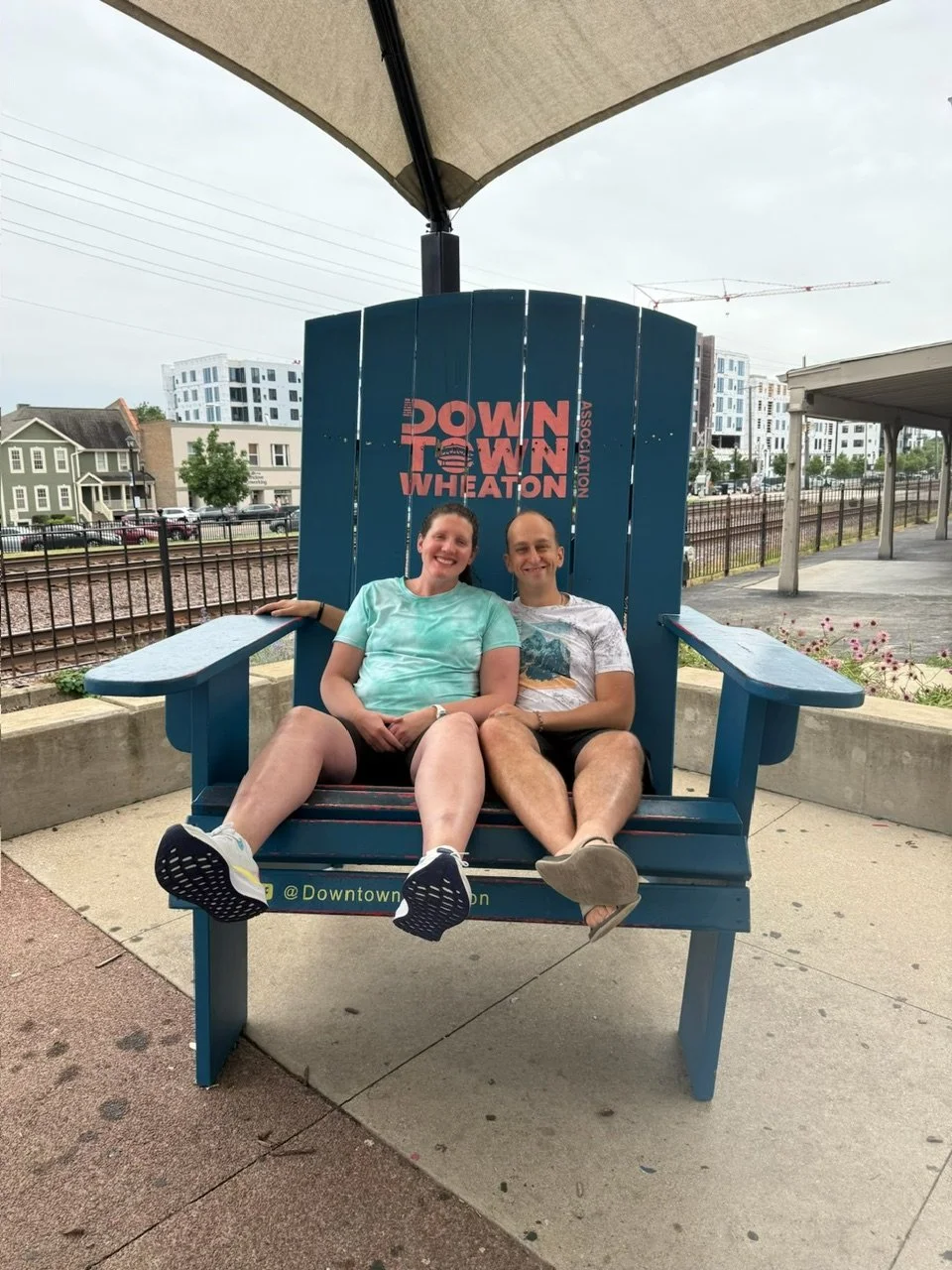
Caleb & Mary Beth in downtown Wheaton IL
The turning points
For both of us, the shift didn't come from a lecture. It came from moments we couldn't unsee.
My turning point: I was teaching the wrong thing
The book that began cracking it open for me was sitting in my own teaching curriculum. A Framework for Understanding Poverty by Ruby Payne lays out the hidden rules that work differently in poverty, the middle class, and the wealthy.
There's a quiz in it. I took it, sure I'd grown up middle class. We each played instruments for crying out loud (even if taught by our older siblings). When I finished the quiz, almost every marker came back showing I grew up in poverty, with slight middle class.
That was humbling. But it quickly became useful. I figured if I had spent my life learning the hidden rules of an impoverished way of living, I could also unlearn it to serve more people.
I especially began looking at the math content I was substitute teaching (while in training). There was lots of algebra, geometry, pre-calc, and calc. There were almost daily questions of “Why do we have to learn this?” from the students I loved. I'd gotten good at answering that math builds problem-solving. Meanwhile, my conviction grew when my own finances were a wreck, and I couldn't have taught what my students actually needed in their real world/financial math if they'd asked.
Whatever those kids went on to do, they'd have to get good at earning, get good at working with people, and taking ownership of their choices. So I started asking for time from anyone further along than me. School leaders. Business owners. They kept telling me a version of the same thing: if you want to lead anything, learn to sell and communicate well, learn to present yourself, and learn to be told no and keep going.
I did NOT want to hear it, because my whole picture of sales was a person learning to manipulate. But I heard it from enough people in enough walks of life that one summer I took a sales job. It was a boiler room, and it was also the first time I sat next to people who'd figured this out. I found I could learn it fast. Nine months in, I was a top-three rep out of ninety-plus people, and the same month got hired over to the corporate training side.
For a homeschooled introvert who thought sales was a dirty word, experiencing these practical life skills change my life was the unlock. Then it turned into something better than personal: I get to hand this to other people.
Mary Beth's turning point: the windshield
While I was working through that, Mary Beth was technically below the poverty line, teaching at a private school for about fifteen thousand a year before tax. Talk about an adjustment from Wheaton IL! She knew where every dollar went because she had no margin, which is ironically where she got good at budgeting.
She still calls the next moment the biggest turning point of her life.
It was winter. At a gas station she lifted her wiper to clear the glass, and something was stuck on the blade. She popped it off to clean it, and the bare metal arm snapped back down and shattered the windshield.
She broke down crying at the pump, because she had no money to fix it. No buffer, no extra, nothing.
She called her mom, expecting a "sweetie, I'll send you something." Her mom told her later it was one of the hardest things she's ever done. What she said instead was:
"Honey, you got yourself into this situation, and I fully believe you can get yourself out of it. Go get ‘em."
Mary Beth is grateful she did. Her mom wasn't knocking her teaching career. She respected exactly what her daughter was doing. She just also knew the financial situation wouldn’t change until MB changed it, and she knew MB wouldn't move until she had to.
So Mary Beth applied everywhere and ended up taking a call-center job answering customer service calls. The first months she was nowhere near the leaderboard, and then something clicked and she became a top rep.
As she saw most new reps cycle in and out and not succeed, she started wondering what she'd tell herself, if she could go back, about what actually makes someone succeed in that role. She built it out into a forty-five-slide deck (she does these things for fun) and handed it to the training team with the agenda, just "see if this helps" the new people.
They ran it with new hires and retention jumped. Hiring is expensive, so when retention moved up, leadership noticed. They pulled MB off the phones and made her the transition trainer, a role that didn't exist until her deck created it. She spent thirty days running huddles, then on the floor with each new hire, listening to calls and coaching.
Not everyone stayed, and she wishes they had. But enough people took what she built and ran with it that she learned something permanent: there are real, teachable skills behind success in any role, and almost nobody gets handed them, especially when new to the working world.
Later a friend called and she landed in a sales boiler room of her own. Manual dialing, a hundred fifty-plus calls a day, hours of getting hung up on. She almost didn't make it, and closed her first deal on the final day of her training window. The next week she closed the biggest deal on the team.
People started asking how. Then she noticed who was asking, the folks making thirty dials a day and coasting on old experience. That was her work-ethic season, and the lesson wasn't clever: to be good at anything, you have to work really hard, and be willing to put the numbers in your favor.
Then came the strange part. She was making six figures, the number she'd thought would be the finish line, and she sat there thinking, this is nice, but is this it?
What we finally realized
We’re shortening this part of our story to not drag… I moved from entry level sales, to a repeat President’s club member in a Fortune 100 company, to starting my own freight agency. Mary Beth crushed and won President’s club and leader boards year-over-year as well before we met, and stayed in high-end sales for long after we met to support my transition to small business owner. Along the way we built income that was more flexible, and in places more passive.
What that bought us wasn't a yacht. It was the ability to ask really scary questions (if living off of one income). Does this high-stress job still make sense? What would fit better? Can we take that time back and hire someone else to mow the yard (lol)? Can we fire that boss who clearly is gaslighting and find a better fit?
Somewhere in there the goal changed. It stopped being "how do we make the most," which was never really the point, and became "how do we make choices that fit how we actually want to live, and lift other people in our community while we do it."
And one idea from Ruby Payne’s work kept resurfacing. Poverty isn't only a lack of money. It's a lack of resources: financial, emotional, mental, spiritual, physical health, support systems, role models, knowledge of the hidden rules. Most people grow up rich in some and short in others. That was true for both of us, in opposite directions.
So we’ve begun building out the resources you see today, once again to “see if this helps”.
Why the project exists
We built this because nobody walked us through this stuff, and we spent years searching and wishing someone had. How money actually works. How to choose a mentor. What business options really exist. How to communicate so people trust you.
So we're having those conversations out loud, in real time, as we keep learning ourselves. We're not gurus and we're not the last word on any of it. The people who moved us most were never selling a course. They were a couple steps ahead and willing to share their hindsight one-on-one. That's what we're aiming to be here, which is also why you'll see us interviewing other people and learning right alongside you.
We expect this to run for years, because there's that much to work through. And when we ask what you need, we do really want the live feedback. There's a place on the resources page to send your questions, and we bring back what we find.
A word to whoever needed this
If you're in that stuck place right now, doing what you were told and still coming up short, I want you to know we started there too, from two different childhoods and one shared frustration. What moved us was studying and learning to understand money differently and then building the skills, one at a time.
That's what the resources on our site are for. We've put work into them and had others look them over for how much they actually help someone starting out. We think they'll help you, and we'd honestly like to hear what does and doesn't land, because that's how they get better for the next person.
You always have a choice to change your situation. We're glad to be, for some of you, a few steps ahead and turning around to share what we've walked thru.
🎯 Start here: theydontteachyou.com/start-here
📩 Get the free Freedom Budget Tracker and browse every resource: theydontteachyou.com/resources
