By Caleb & Mary Beth Lutz · October 8, 2026 · pairs with Communication Skills Are the Real Reason You're Not Getting Promoted
You're good at your job. Maybe even the best on your team. And you keep watching people who do less get promoted ahead of you.
We get it. It isn't really fair. But here's the hard truth: usually it's Not your work alone that's holding you back. For the hard worker, the high performer, the go-the-extra-mile person, it's much more likely that it’s your communication that’s holding you back. And that's actually great news, because communication is a skill you can build… starting now.
This is a written companion to our video on exactly that, and the full episode is below. This one matters a lot to us, because some of the best people we know have no idea they have a voice, or that speaking up could make them a real difference-maker for their company and their mission. If you'd rather read, we cover four things: why great work alone doesn't get you promoted, the communication skills that actually get you noticed, the mistakes quietly holding you back, and how to start being seen this week.
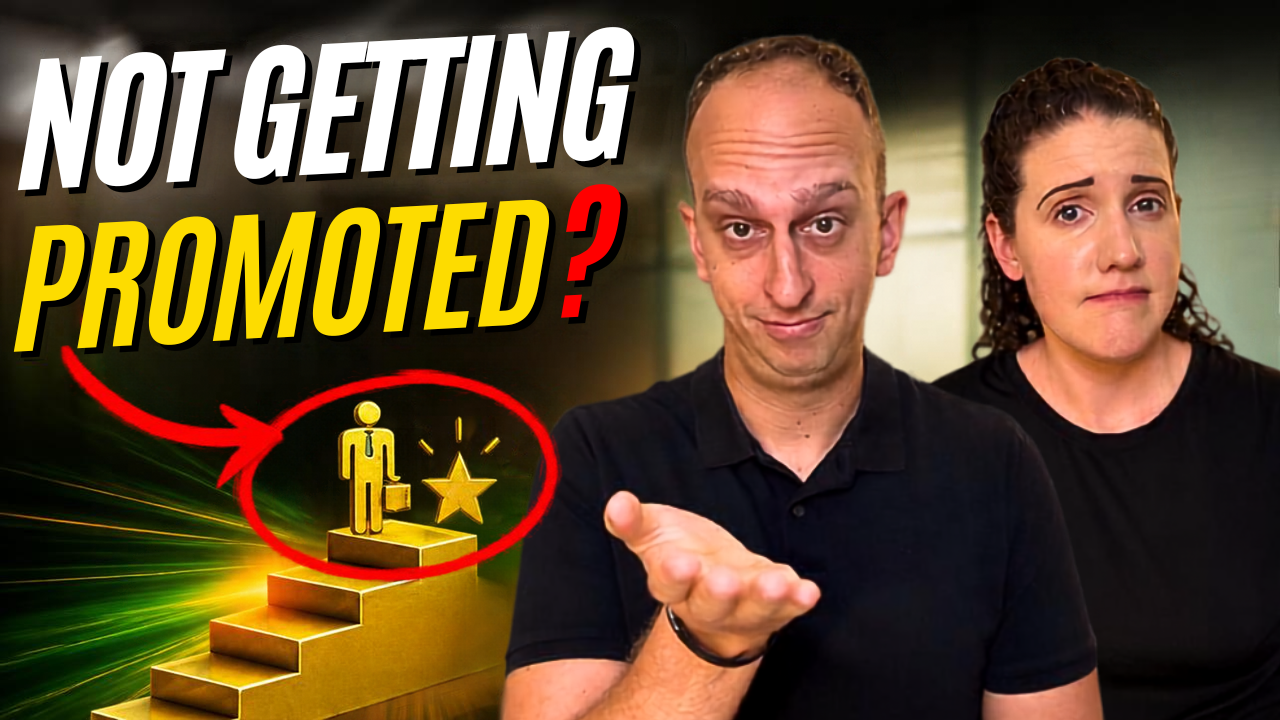
Watch "Communication Skills Are the Real Reason You're Not Getting Promoted"
Point 1: Why great work alone doesn't get you promoted
We thought the work spoke for itself too. In our live episode, Caleb shares how he grew up in a family where humility was the whole foundation of the work game: you do more than you say, you keep your head down, and you wait for someone to notice and open the golden door for you. There's real merit there. Your work should be the number one way you communicate your value, so if you're not doing great work yet, that's step one.
But here's the part that stings: nobody promotes work they can't see.
Be honest, most of us spend most of our day thinking about ourselves and our own plate. Your boss included (thinking about themselves, not you). So when there are a hundred moving parts, what a leader is quietly asking is, "what's the story I could tell about this person?" If they don't have a clear answer… that's often the real reason the promotion goes to someone else. Promotions go to people who make their value obvious and easy to talk about.
We'll get to how to do this without being obnoxious. Communicating your value really is an art to develop. It can start as simple as you being able to say: "here's what you told us you wanted, here's what we delivered, and here's how much time it just saved you."
Point 2: The communication skills that get you noticed
Start with clarity. When you talk to your boss or a potential customer, do they actually know what you've done and how you can help? Or is it cluttered? It is so easy to over-share, piling on backstory and context because you want them to understand the whole journey. But a leader deciding "do I invest here, do I promote this person" has very little time. Get to the point fast. Have the deeper detail ready for when they ask.
Then, speak in outcomes, Not activity. This is the big one. Don't say "I did the report." Say "When I ran the report, here’s what we found, and here are the 5 hours it just saved us, we won't have to guess about how to be effective at this again." One of those is noise. The other is value, and they hear it instantly.
We laugh a little recording/writing this, because we've both sat on the leadership side. There is already a MOUNTAIN on the plate of anyone running a team. So when someone walks up and spends five to ten minutes unloading everything in their head, the story it tells a leader is Not "wow, thorough." It's "This person can't communicate concisely. They aren’t respecting my time, and probably won’t respect my customer’s time." » Our recommendation: flip it. "I know your time matters, you've got two minutes, I ran a report, I think it saves us five or six hours, and I think we've got enough to make a decision." That person has your full attention. That person, you want working with you more.
Two more quick thoughts. One, own the win. If a real contribution came from effort you put in, do own it directly & simply vs dodging acknowledgement.
Two. And if you're not sure which win to spotlight, ask what matters most. Picture someone cleaning a house: "of everything on the list, what are the top two things you absolutely need done well?" Once you know the top priorities, you deliver on those and you speak to exactly those. Come in with a few clear bullet points, not a wall of words, because it quietly says "I respect your time" to someone juggling 50,000 things.
Point 3: The mistakes quietly holding you back
The biggest one? Over-explaining. We almost can't over-explain how much over-explaining is costing you (see what we did there).
We’ve all sat through a friend of a friend taking a solid 10 minutes to give us their entire backstory, when two or three sentences would have been enough. Then we could have asked for more, heard another 30 seconds, and thought, "wow, very cool, way to go." Instead, the quiet message was the opposite: this person isn't respecting our time, isn’t aware of how self-focused they are, and… maybe can't make a decision when it counts. In business terms, over-explaining tells a leader you're thinking about yourself, not the business.
A few more.
Waiting to get noticed instead of sharing your wins. We’re already shared a bit on how this can hold you back.
Only speaking up when something's wrong. In a leadership circle there's a role some people call the guardian, the one who always spots what could pop the bubble. Caleb has a good amount of guardian in him, and he has had to learn to preface critiques with, "is this the moment to paint the vision, or are we actually moving to execution?" Because he can always see a dozen things that might get in the way of getting the vision done.
If you’re an operator/guardian, here’s a quick marriage story that’s a good analogy for how to Not work well with a visionary.
In our early years of marriage, Mary Beth was the natural visionary. The promoter. "Here's where we're going, A to Z, let's GO." Caleb, with all that guardian in him, would be seeing the work required for A to B, B to C, C to D, etc. Mary Beth would get excited blowing up a big beautiful balloon of an idea… and Caleb’s instant reflex was "so here’s why that won't work." POP. It took an executive coach Caleb was paying to finally name it: "You realize your wife/customer/team lead is taking all this time to blow up the balloon, and you're standing there with a pin to pop it?"
That one picture changed everything. The move isn't to stop being an operator/guardian. It's to keep the balloon up first, then ask, "do you need anything to help tie this off so it doesn't just float away?" i.e. How can we help you actually make this happen? Same thing at work. Find the missing gap. Then ask whether the person is even open to feedback yet, or whether you're both still in vision mode. Sometimes you're the guardian who needs to let the balloon rise. Sometimes you're the one who has to breathe life into it, "actually, I think we CAN do this… would it help if we handled that part for you?" Filling that gap, for a manager or a customer, is what earns you the next level.
One last mistake: saying yes to everything. If you over-commit, leading a group here, running a thing for the team there, you split yourself so many directions you never shine where you actually shine. Know your lane. Narrow in.
Point 4: How to start being seen this week
Good news on two fronts. This isn't an overhaul. And if you haven't been doing any of these, doing even one will make you stand out fast.
A few bullet-point practicals:
Send your boss a short update about a recent win. Short. Concise. Bulleted. Not a wall of paragraphs.
In your next meeting, actually say out loud one clear point to address for your customers.
Take that rambling email sitting in your drafts and cut it to 2-3 tight sentences. And start framing your work as outcomes, not activity.
Caleb's honest habit with the paragraph-long email is to sit on it a day. Then the next morning: "yeah, they don't need any of that. Here's the 1-2 lines they actually need." That filter, what is me processing versus what actually serves the other person, is the whole ballgame.
The takeaway
To recap the four: (1) great work alone doesn't get you promoted because nobody promotes what they can't see; (2) the skills that get you noticed are clarity, outcomes over activity, and owning the win; (3) the mistakes holding you back are over-explaining, staying quiet, only critiquing, and over-committing; and (4) you can start being seen this week with one short win update, one clear point in a meeting, and outcome-framed communication.
Here's what we most want you to hear. The best person on the team and the person who gets promoted are often two different people… and the gap between them usually isn't talent. It's being seen.
If you want to sharpen how you come across, keep an eye out for our Authentic Sales Playbook, coming soon to the resources page. We know, "sales." But it's really about communicating your value clearly, whether that's for a product, a service, or yourself, so it works inside a company as you're trying to grow, too.
And remember, you always have the choice to change your life. It's up to you to choose it. We believe in you, and we're here for you.
🎯 Start here: theydontteachyou.com/start-here
📩 Keep an eye out for the Coming Soon Authentic Sales Playbook and browse every resource: theydontteachyou.com/resources
